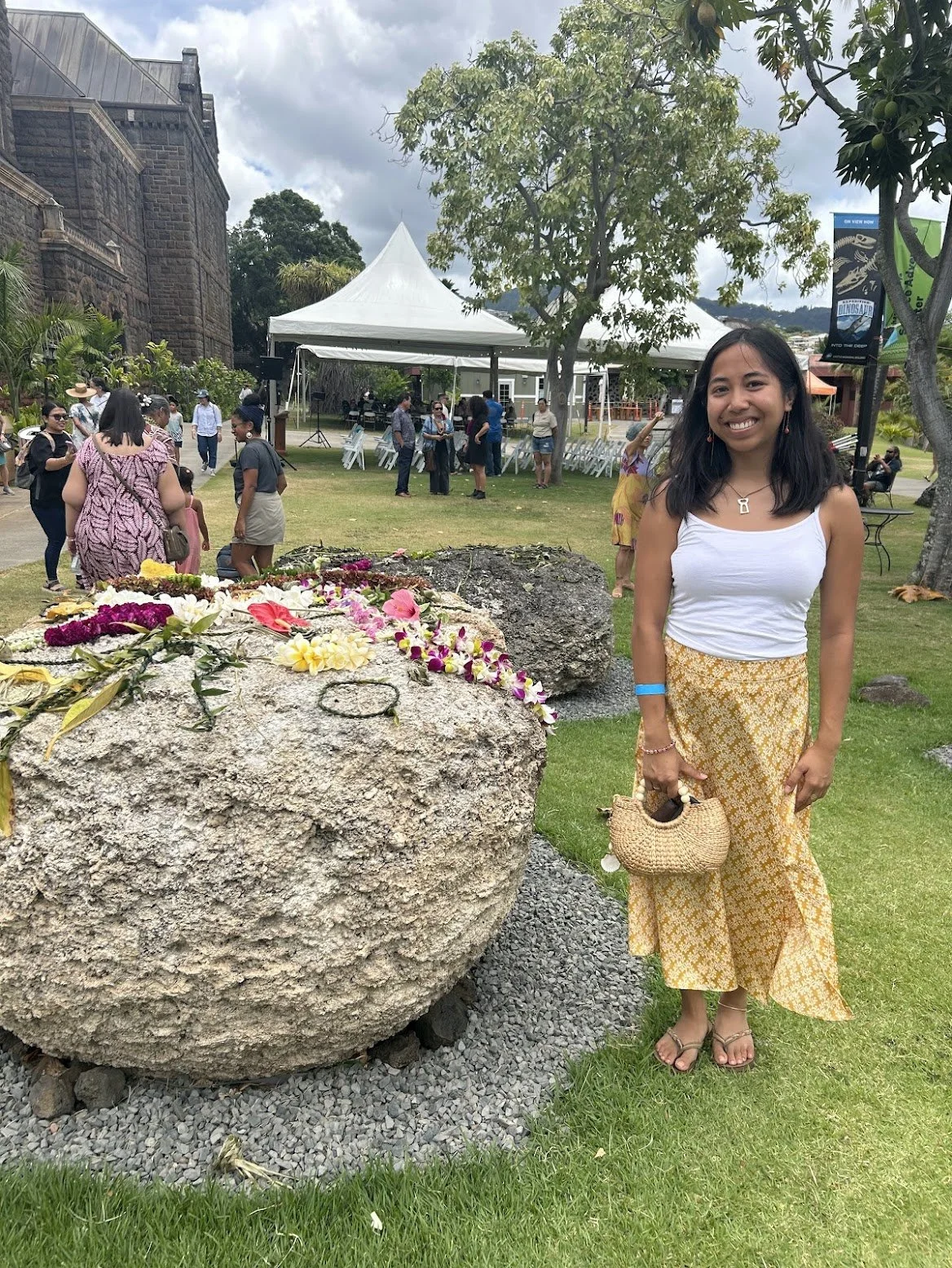
Alexandria Malilay
2025-present: Ph.D. Student, NSF GRFP Fellow, Hawai’i Institute of Marine Biology, University of Hawai’i
2023-25: RAY Fellow & Coral Reef Fisheries Liaison, NOAA Fisheries, Santa Rosa, CA & Guam
2018-22: B.A., Environmental Biology, I.I. Rabi Scholar, Columbia University, NYC, USA
It all started when…
My connection to the ocean begins with my family. I remember the first time I saw pulos in the waters of Guam, the island where my parents grew up. The sunlight glinted on their scales at the water’s surface, and the school of fish drifted above the mosaic of colors from the reef below. Carrying these memories of the sea with me, I have always sought to learn more about i tåsi (the ocean) and the languages and stories of my people.
This pursuit led me to Columbia University, where I was designated an I.I. Rabi Scholar and earned a B.A. in Environmental Biology. For my senior thesis, I conducted an accuracy assessment of widely used remote sensing data products for the shallow reefs of Tepungan Bay, Guam. I also documented the CHamoru digital language learning community that formed as a result of the pandemic through an ethnolinguistic profile. Following my degree, I returned to California to work with NOAA Fisheries where I collaborated with agency partners and stakeholders to promote coastal habitat protection, conservation, and ecosystem-based resource management. I then transitioned to a role as a coral reef fisheries liaison to assist the development of a sustainable fisheries management plan with the Government of Guam.
Currently, I am pursuing a teaching certificate with the Center for Pacific Islands Studies and a Ph.D. in Marine Biology. My family’s roots guide my research and activism for the protection of our reefs and the self-determination of people of the Pacific.
My research...
I am interested in looking at spatial-temporal patterns of reef habitat to better understand coral reef ecology and inform ecosystem-based management practices. My current research explores the carbon storage capacity of coral reef halos within and outside of marine preserves, which will inform us on the ways that predation risk impacts marine ecosystem structure over time. I also seek to combine fisheries dependent and independent data to assess how different types of fishing gear impact vulnerable fish families. My work will be informed by the traditional ecological knowledge that my community holds.
What I've written...
Voices of Bay Area Restoration
Contact me…
Email:
amalilay@hawaii.edu
Address:
Hawaii Institute of Marine Biology
University of Hawaii at Manoa
PO Box 1346 (for US Postal Service)
46-007 Lilipuna Road (For all other carriers)
Kaneohe, HI 96744 USA